A shampoo bottle may require a branding label on the front and an ingredient label on the back. A chemical container may use one label for product identification and another for instructions or regulatory information.
In these applications, the challenge is not simply applying two labels. Both labels must remain correctly positioned relative to the container and to each other while the product moves through the production line.
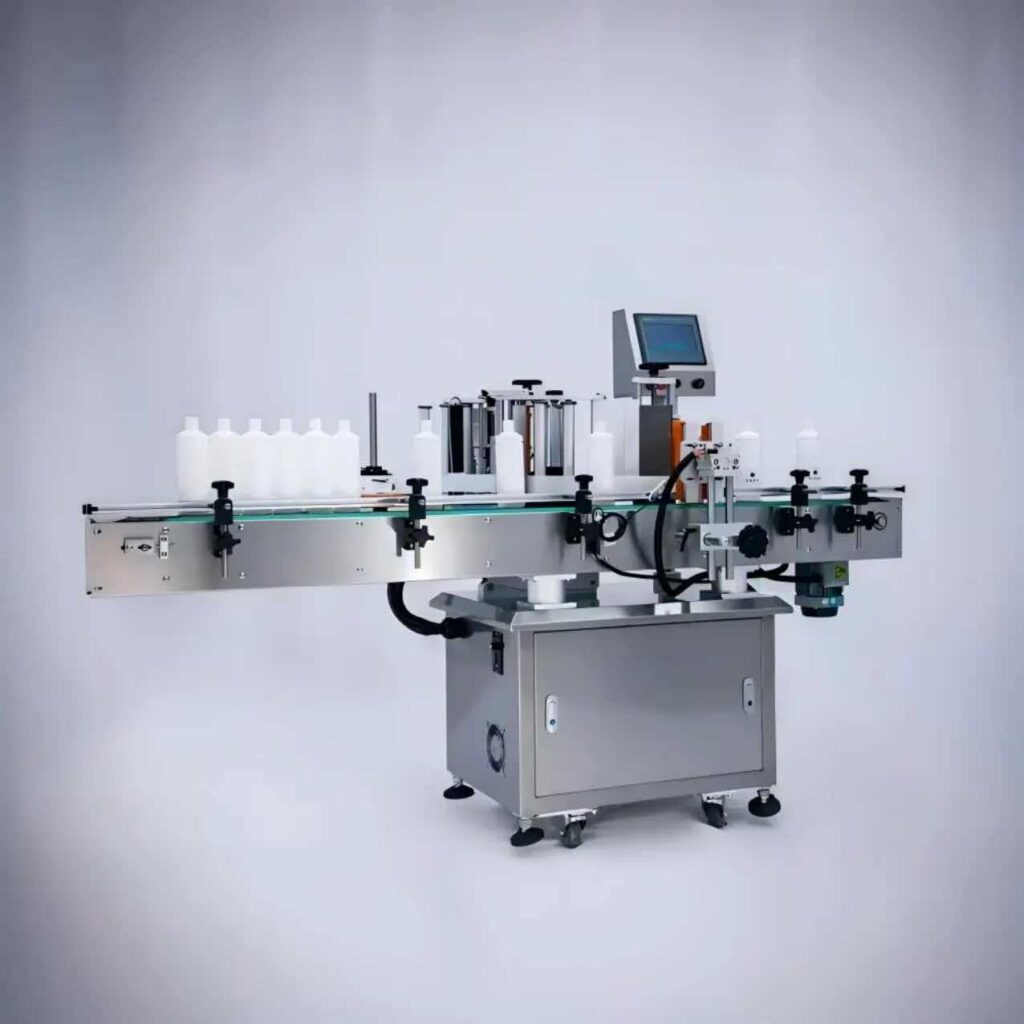
A front and back labeling machine is designed for this type of application. It typically uses two labeling heads to apply separate labels to opposite sides of a container during a continuous production process.
However, not every two-label application requires the same machine configuration. Bottle shape, product stability, label position, production speed and orientation requirements all affect how the labeling system should be designed.
This guide explains how front and back labeling works, which containers are suitable, what affects labeling accuracy, and what information should be evaluated before selecting a machine.
What Is Front and Back Labeling?
Front and back labeling refers to applying two separate labels to different sides of the same container, typically one label on the front panel and another on the back panel.
The two labels may serve different purposes. For example, the front label may display the product name and branding, while the back label contains ingredients, instructions, technical information or regulatory content.
Unlike wrap-around labeling, where a single label follows the circumference of a container, front and back labeling keeps the two labels separate.
This makes the process particularly suitable for containers with clearly defined front and back surfaces, such as flat, oval and rectangular bottles.
For machine configurations designed specifically for this process, see our Automatic Vertical Double-Sided Labeling Machine.
How Does a Front and Back Labeling Machine Work?
1. Product Feeding and Separation
Containers enter the labeling conveyor from the upstream production process. A bottle separation mechanism creates sufficient spacing between products so that each container can be detected and labeled independently.
2. Product Guidance and Stabilization
Before labeling, the container must remain stable while passing the labeling heads. Guide rails, pressing belts or other stabilization mechanisms may be used depending on the bottle shape.
This is particularly important for tall, narrow, lightweight or irregular containers. If the product rotates, tilts or shifts laterally during labeling, the final label position may vary even when the label dispensing system itself is accurate.
4. Front and Back Label Dispensing
Two labeling heads are typically installed on opposite sides of the conveyor.
When the product reaches the labeling position, each labeling head dispenses its corresponding label according to the preset timing and product position.
5. Label Pressing and Discharge
After the front and back labels are dispensed onto the container, they still need to be pressed firmly against the product surface.
Depending on the container shape and label position, the machine may use pressing plates, sponge rollers, belts or other pressing mechanisms to ensure that the labels make consistent contact with the bottle surface.
This step is particularly important for oval, flat and shaped containers. If the bottle is not properly supported during label application, it may shift or tilt as the labels are pressed, resulting in inconsistent label positions.
The pressing mechanism should therefore work together with the product guiding system rather than simply applying more pressure.
Several factors can affect the final result:
- Bottle shape and surface geometry
- Container rigidity
- Label material and adhesive
- Label size and application area
- Conveyor stability
- Pressing pressure
- Product speed
After pressing is completed, the labeled container leaves the labeling section and continues to the next production process.
Depending on the production line, downstream equipment may include coding machines, inspection systems, filling equipment, cartoning machines or other packaging equipment.
For applications where front and back label alignment is especially important, the finished products should also be checked under actual production conditions rather than evaluating only a few bottles at low speed.
Which Containers Are Suitable for Front and Back Labeling?
Front and back labeling is commonly used when a product requires two separate labels on different surfaces of the same container.
However, whether a standard front and back labeling system is suitable depends largely on the geometry of the container.
A bottle that naturally maintains a stable orientation on the conveyor is generally easier to label than a product that can rotate freely during transportation.
The following container types are commonly used with front and back labeling systems.
Flat Bottles
Flat bottles are among the most common applications for front and back labeling.
Because the container has clearly defined front and back surfaces, two separate labels can be applied to opposite sides as the bottle passes between the labeling heads.
Typical applications include:
- Personal care products
- Household cleaning products
- Chemical containers
- Lubricant bottles
- Food products
The main consideration is product stability.
Tall or narrow flat bottles may move laterally or tilt while traveling through the labeling section. In these cases, appropriate guide rails, pressing belts or other stabilization mechanisms may be required to maintain a consistent bottle position.
The relationship between bottle width, label size and available labeling surface should also be checked before machine configuration.
Oval Bottles
Oval bottles are another common application for front and back labeling.
Unlike a perfectly round bottle, an oval container has naturally defined front and back surfaces. This makes it possible to apply separate labels to both sides without necessarily requiring a complex rotational positioning system.
However, the curved transition between the front surface and the sides of the bottle can affect label application.
If a label is too wide for the relatively flat labeling area, part of the label may extend into the curved section of the container. This can increase the risk of wrinkles, bubbles or inconsistent adhesion.
For this reason, machine evaluation should consider both the overall bottle dimensions and the actual usable labeling area.
Bottle stability is also important. Some oval containers can rotate slightly while moving along the conveyor, especially when the bottle base is narrow or the product has an uneven center of gravity.
The guiding and stabilization system should therefore be evaluated together with the labeling heads.
Rectangular Containers
Rectangular containers usually provide clearly defined labeling surfaces and can be suitable for automatic front and back labeling.
Typical examples include bottles and containers used for:
- Chemicals
- Automotive fluids
- Household products
- Food products
- Personal care products
Although the surfaces may appear simple to label, container dimensional tolerance should still be considered.
Plastic bottles can vary slightly because of molding conditions, wall thickness and product filling. If the bottle shape changes under pressure or during conveying, the distance between the labeling head and the application surface may also change.
A suitable machine configuration should therefore accommodate normal production variation rather than being adjusted only for one ideal sample.
Shampoo, Detergent and Personal Care Bottles
Shampoo, detergent and personal care packaging frequently uses separate front and back labels.
The front label normally carries the brand name and primary product information, while the back label may contain ingredients, instructions, warnings, barcodes or other information.
These products can present additional challenges because bottle designs are often created for visual appearance rather than labeling convenience.
For example, a bottle may have:
- Curved surfaces
- Narrow labeling areas
- Asymmetrical shapes
- Flexible plastic walls
- Offset caps
- Uneven bases
In these cases, simply selecting a standard two-head labeling machine may not be enough.
The bottle should first be evaluated to determine how it will be guided and stabilized through the labeling area.
Chemical and Household Product Containers
Chemical and household product bottles often require two labels because a large amount of product, safety and regulatory information must be displayed.
These containers may also have handles, irregular profiles or relatively large dimensions.
A handle can be particularly important because it creates a defined product orientation. If the labels must maintain a specific relationship with the handle, additional product orientation or positioning may be required before labeling.
This is an important distinction:
A machine capable of applying two labels does not automatically guarantee that those labels will maintain a fixed position relative to a handle, logo, seam or other bottle feature.
When this type of alignment is required, the application should be evaluated as a positioning requirement rather than only a front and back labeling requirement.
Can Round Bottles Use Front and Back Labels?
Yes, but round bottles require additional consideration.
A round bottle can rotate freely around its vertical axis. Therefore, applying two separate labels to a round container is different from labeling a flat or oval bottle that naturally maintains its orientation.
If the exact rotational position of the labels is not important, a suitable labeling configuration may still be possible.
However, if the front label must align with a logo, molded feature, seam or another reference point, the bottle orientation needs to be controlled before the labels are applied.
This is where position labeling becomes relevant.
For applications that require labels to maintain a fixed relationship with a bottle feature, see our Position Labeling Machine Guide for a detailed explanation of product orientation, positioning methods and machine selection.
Front and Back Labeling vs Wrap-Around Labeling
Front and back labeling and wrap-around labeling are both widely used for bottles and containers, but they solve different packaging requirements.
The main difference is the relationship between the label and the container.
A front and back labeling system applies two separate labels to different areas of the product. A wrap-around labeling system typically applies one label around part or most of the circumference of a round container.
| Requirement | Front & Back Labeling | Wrap-Around Labeling |
|---|---|---|
| Label configuration | Two separate labels | Usually one continuous label |
| Typical containers | Flat, oval, rectangular and shaped bottles | Mainly round containers |
| Separate front/back graphics | Yes | Usually not required |
| Full circumference coverage | No | Possible |
| Bottle stabilization | Important | Important |
| Rotational control | Depends on application | Depends on application |
| Typical purpose | Separate branding and information panels | Continuous circumferential labeling |
For example, an oval shampoo bottle may use a large branding label on the front and a separate ingredients label on the back. In this case, front and back labeling is usually the more logical configuration.
A cylindrical beverage bottle, on the other hand, may use one label that wraps around most of the bottle circumference. A wrap-around labeling system may therefore be more appropriate.
The correct choice should not be based only on the number of labeling heads.
The following factors should be evaluated together:
- Container geometry
- Number of labels
- Label dimensions
- Required label position
- Available labeling surface
- Production speed
- Whether rotational orientation must be controlled
In some applications, the distinction is less obvious. A round bottle, for example, may require two separate labels positioned at specific angles. This can require both multiple labeling heads and a product positioning system.
What Determines Front and Back Labeling Accuracy?
Labeling accuracy is not determined by the labeling head alone.
The final position of a label is the result of several mechanical, electrical and material factors working together.
This is especially important in front and back labeling because errors can be more visually obvious when two labels are compared on the same container.
1. Bottle Stability
The bottle must remain in a predictable position while passing the labeling heads.
If the container moves sideways, rotates or tilts during label application, the final label position can change even if the labeling head dispenses every label consistently.
Tall bottles, lightweight containers and products with narrow bases generally require more attention to stabilization.
Guide rails, pressing belts and other product-control mechanisms can help maintain a stable path through the labeling section.
2. Container Dimensional Variation
Real production bottles are not always identical.
Plastic containers may have dimensional variations caused by molding, wall thickness, temperature or filling conditions.
Flexible bottles may also deform when pressure is applied.
This means machine evaluation should not rely only on one perfect sample.
Where possible, representative samples from normal production should be tested so that the machine configuration can accommodate realistic product variation.
3. Label Detection and Dispensing
The labeling system needs to detect the position of each label on the backing material and control when the label is dispensed.
Incorrect sensor settings, inconsistent label gaps or unsuitable label materials can affect dispensing consistency.
The label roll itself should therefore be included when evaluating the application rather than considering only the bottle.
4. Conveyor Speed and Synchronization
The conveyor, product detection system and labeling heads must work in coordination.
Increasing production speed reduces the amount of time available for product detection, label dispensing, pressing and stabilization.
For this reason, labeling performance should be evaluated at the required production speed rather than only during slow manual testing.
A machine that produces good samples at low speed does not automatically guarantee the same result under continuous production conditions.
5. Label Material and Adhesion
Label material can influence the final labeling result.
Factors such as label stiffness, adhesive characteristics and backing material can affect how the label separates from the liner and adheres to the bottle.
The container surface also matters.
Dust, moisture, oil or an unsuitable surface condition can reduce adhesion even when the label is applied in the correct position.
For projects where label placement consistency is particularly important, machine settings, bottle samples and actual production labels should ideally be evaluated together.
For a deeper explanation of these variables, see our guide to factors affecting labeling machine accuracy.
Does Front and Back Labeling Require Product Positioning?
Not always.
This is an important distinction when selecting a labeling machine.
Many flat, oval and rectangular containers already have clearly defined front and back surfaces. With appropriate guiding and stabilization, the machine can maintain these surfaces in the correct orientation while the product passes through the labeling area.
In this situation, a standard front and back labeling configuration may be sufficient.
Product positioning becomes more important when the label must align with a specific reference on the container.
Typical examples include:
- A molded logo
- A bottle handle
- A mold seam
- An embossed feature
- A printed registration mark
- An existing label
- A cap or closure feature
In these applications, it is not enough for the machine to know that a bottle has arrived.
It also needs to determine which direction the bottle is facing.
For example, consider a round bottle with an embossed logo.
If the bottle enters the labeling machine at a random rotational position, applying the label at the same machine position every time does not guarantee that the label will align with the logo.
The container must first be oriented according to the required reference point.
Therefore, there are two different questions to consider:
Front and back labeling asks:
Where should the two labels be applied?
Position labeling asks:
How should the product be oriented before the label is applied?
Some applications require only the first function. Others require both.
If your application requires alignment with a handle, seam, logo or another fixed product reference, read our Position Labeling Machine Guide before selecting the machine configuration.
How to Choose a Front and Back Labeling Machine
Selecting a front and back labeling machine should begin with the product and labeling requirement rather than with a machine model.
Two bottles that both require front and back labels may need very different machine configurations because of differences in shape, stability, label size and production speed.
Before requesting a quotation, evaluate the following factors.
1. Container Shape and Dimensions
Start with the basic product dimensions:
- Height
- Width
- Thickness or diameter
- Base dimensions
- Container shape
The machine supplier should also know whether the product is flat, oval, rectangular, round or irregular.
Bottle geometry determines how the product can be transported, guided and stabilized through the labeling area.
2. Front and Back Label Dimensions
Provide the dimensions of both labels separately.
The front and back labels do not necessarily have the same size.
The machine manufacturer should know:
- Front label width and height
- Back label width and height
- Gap between labels on the backing material
- Label roll direction
- Label material
Actual label samples are preferable when available.
3. Required Label Position
A drawing or marked bottle photo is often more useful than simply describing the required position in text.
Clearly indicate where the front and back labels should be applied.
Also specify whether the labels need to align with:
- Bottle edges
- Handles
- Molded features
- Existing printing
- Caps
- Seams
- Other labels
This information helps determine whether standard product guidance is sufficient or additional positioning is required.
4. Required Production Speed
Do not select a machine based only on the maximum speed shown in a specification table.
The practical production speed depends on the complete application, including:
- Bottle dimensions
- Label dimensions
- Label quantity
- Product spacing
- Stabilization requirements
- Positioning requirements
- Upstream and downstream equipment
Provide the required production output in bottles per minute or bottles per hour.
The machine configuration can then be evaluated around the actual production target.
5. Product Stability
A container that stands steadily on a wide, flat base is generally easier to handle than a tall, lightweight or irregular bottle.
Consider whether the bottle can:
- Tilt
- Rotate
- Move sideways
- Deform under pressure
- Become unstable at higher conveyor speeds
These factors may determine whether additional guiding or stabilization mechanisms are required.
6. Product Changeover Requirements
If several bottle formats will run on the same production line, provide information for all planned products during the initial evaluation.
Do not evaluate only the first bottle.
The supplier should determine which components can be adjusted and which may require replacement during product changeover.
This can significantly affect future operating convenience and tooling costs.
7. Integration With the Existing Production Line
A labeling machine rarely operates completely independently in an automated packaging line.
The supplier should understand what equipment is installed before and after the labeling machine.
For example:
- Filling machine
- Capping machine
- Bottle unscrambler
- Coding machine
- Inspection system
- Cartoning machine
- Packing equipment
Line height, conveyor direction, available installation space and required communication between machines may influence the final layout.
8. Coding and Inspection Requirements
Some projects require additional operations during or immediately after labeling.
Examples include:
- Batch coding
- Date printing
- Barcode verification
- Label presence detection
- Vision inspection
- Reject systems
These requirements should be discussed during machine design rather than added after the labeling system has already been manufactured.
What Information Should You Send to a Labeling Machine Manufacturer?
The quality of a machine recommendation depends heavily on the information available during project evaluation.
Before requesting a quotation, prepare as much of the following information as possible:
- Product photos
- Bottle drawings or dimensions
- Bottle material
- Filled or empty bottle condition during labeling
- Front label dimensions
- Back label dimensions
- Label material
- Required label positions
- Required production speed
- Number of product formats
- Existing production line layout
- Conveyor direction
- Available electrical supply
- Coding requirements
- Inspection requirements
For unusual bottle shapes or applications requiring precise orientation, physical product and label samples may also be required before the final machine configuration is confirmed.
Providing this information early helps the equipment supplier evaluate the complete application rather than recommending a machine based only on bottle size.
Example: Selecting a Labeling System for an Oval Shampoo Bottle
Consider a simplified example of an oval shampoo bottle requiring a branding label on the front and an ingredients label on the back.
This is an illustrative example rather than a specific customer project.
The first question is whether the bottle remains stable and maintains its front-to-back orientation while moving along the conveyor.
Because the bottle is oval, its geometry may naturally help maintain orientation. However, the actual stability still depends on the base shape, bottle height, weight distribution and conveyor conditions.
Next, the available labeling surfaces should be checked.
If either label extends too far into the curved side of the bottle, label pressing and adhesion may become more difficult. The label dimensions should therefore be evaluated against the usable front and back surfaces.
The next consideration is production speed.
At higher speeds, product spacing, bottle stabilization and synchronization between the two labeling heads become increasingly important.
Finally, the required label relationship must be confirmed.
If the labels only need to remain centered on the natural front and back surfaces, a standard double-sided configuration may be suitable.
If the labels must also align with a molded logo, cap orientation or another specific reference, additional product positioning may be required.
This example illustrates why machine selection should begin with the complete application rather than simply choosing a machine described as a “double-sided labeler.”
Common Mistakes When Selecting a Front and Back Labeling System
1. Choosing the Machine Based Only on Maximum Speed
Maximum machine speed does not necessarily represent the achievable speed for every product.
Bottle stability, label dimensions, positioning requirements and downstream processes can all affect practical output.
Evaluate the machine using your actual product and production requirement.
2. Ignoring Bottle Stability
Many labeling problems that appear to be caused by the labeling head are actually related to product movement.
If the bottle rotates, tilts or moves laterally during application, consistent label placement becomes difficult.
Product guidance and stabilization should therefore be evaluated as part of the labeling system.
3. Evaluating the Machine Without Actual Labels
Bottle dimensions alone are not enough.
Label size, material, backing paper, adhesive and application position can all affect the final result.
Whenever possible, provide representative bottles and actual labels during machine testing.
4. Considering Only the Current Bottle
A machine may work well for one product but require significant modification for future formats.
If additional bottle sizes or shapes are already planned, include them during the initial project evaluation.
This allows changeover requirements and tooling compatibility to be considered before the machine is manufactured.
For additional troubleshooting information, see our guide to common labeling problems and how to solve them.
Frequently Asked Questions
Can a labeling machine apply front and back labels at the same time?
Yes. A front and back labeling machine can use two labeling heads positioned on opposite sides of the conveyor to apply separate labels during the same production process.
The exact arrangement depends on the bottle shape, label dimensions, required position and production speed.
What is the difference between a double-sided labeling machine and a wrap-around labeling machine?
A double-sided labeling machine normally applies two separate labels to different surfaces of a container, such as a front branding label and a back information label.
A wrap-around labeling machine normally applies a label around part or most of the circumference of a round container.
The correct system depends on the container geometry and required label layout.
Can a front and back labeling machine label round bottles?
Yes, but round bottles require additional consideration because they can rotate freely during conveying.
If the exact rotational position of the labels is important, the machine may require a product positioning system before label application.
Can different bottle sizes run on the same labeling machine?
In many applications, one machine can accommodate multiple bottle sizes through mechanical adjustments or change parts.
However, compatibility depends on the differences in bottle dimensions, shape, label size and required label position.
All planned bottle formats should therefore be evaluated before the final machine configuration is confirmed.
Does front and back labeling require bottle positioning?
Not necessarily.
Flat, oval and rectangular containers can often maintain a predictable orientation through suitable guiding and stabilization.
Additional positioning is usually required when the label must align with a specific reference such as a handle, logo, seam, embossing or printed mark.
For these applications, see our Position Labeling Machine Guide.
What causes front and back labels to become misaligned?
Misalignment can result from several factors, including bottle movement, unstable conveying, incorrect sensor settings, inconsistent label dispensing, container dimensional variation or unsuitable product guiding.
Because these factors interact with each other, labeling accuracy should be evaluated under actual production conditions rather than by checking the labeling head alone.
Before Requesting a Quotation
A useful quotation for a front and back labeling machine requires more than a bottle diameter and target speed.
If you already have your packaging samples or drawings, prepare the bottle dimensions, front and back label sizes, required label positions and production speed before contacting the equipment supplier.
For products with handles, molded features, irregular shapes or strict orientation requirements, include photos showing exactly where each label should be positioned.
This allows the application to be evaluated before the machine configuration is selected.
Not Sure Which Labeling Configuration Fits Your Bottle?
Send us your bottle photos or drawings, front and back label sizes, required label positions and production speed. Our team can review the application and help determine whether standard double-sided labeling, product positioning or a customized configuration is required.