Automatic Front & Back Labeling Machine for Flat, Square & Oval Bottles
This automatic double sided labeling machine uses two independent servo-driven labeling heads to apply front and back self-adhesive labels in one continuous process. It can be configured for flat, square, rectangular and oval bottles, with bottle handling adapted to the actual container shape.
For a front-and-back labeling recommendation, please share your container shape and dimensions, front and back label sizes, target production speed, country and whether the machine must connect to an existing line.
See our France double-side labeling machine case study →
Compare automatic labeling machines for different bottle shapes and label positions →


Front and Back Bottle Labeling in One Conveyor Pass
The machine applies separate front and back pressure-sensitive labels while the bottle travels through one continuous labeling process. Two independently controlled servo labeling heads allow the front and back label positions to be adjusted for the actual bottle and label layout.
Primary applications include flat, square, rectangular and oval bottles. Round bottles can also be evaluated with a suitable customized handling or wrap-around labeling configuration rather than treating every round-bottle application as a standard setup.
When Do You Need a Double-sided Labeling Machine?
A double-sided labeling machine is designed for containers that require separate front and back labels in one continuous production process.
Front and Back Labels Are Different
Choose a double-sided labeler when the front label carries branding while the back label contains ingredients, instructions, regulatory information or product specifications.
Flat, Square or Oval Bottles
Containers with two defined labeling surfaces are better suited to dual labeling heads than conventional round bottle wrap-around systems.
Both Labels Must Be Applied in One Pass
Two labeling heads can apply the front and back labels during the same conveyor cycle, reducing manual handling and avoiding a second labeling process.
Double-sided Labeling Machine Applications for Different Industries
This automatic double-sided labeling machine is widely used for cosmetic bottles, detergent bottles, food containers, beverage bottles and pharmaceutical packaging that require accurate front and back labeling.
Cosmetic Bottles
Shampoo bottles, lotion bottles, skincare bottles and cosmetic containers.
Food & Beverage
Juice bottles, sauce bottles, condiment bottles and flat food containers.
Daily Chemical
Detergent bottles, cleaning product bottles and household chemical containers.
Pharmaceutical & Healthcare
Healthcare bottles, medicine containers and flat pharmaceutical packaging.
Dual Servo Labeling Heads for Front & Back Application
Two independent servo-driven labeling heads, bottle guiding and application-specific fixtures work together to support stable front and back label placement.
Front & Back Labeling
Two independent labeling heads apply separate front and back labels during one continuous conveyor pass.
Stable Bottle Clamping
Guiding and positioning structure helps keep bottles stable during labeling.
Servo Motor Control
Servo-driven label feeding improves label placement accuracy and consistency.
Multiple Bottle Shapes
Configured for flat, square, rectangular and oval bottles. Round-bottle applications can be customized when required.
Touchscreen Operation
PLC and touchscreen control make parameter adjustment and product changeover easier.
Line Integration
Can be integrated with filling, capping, coding and downstream packaging equipment.
Key Components of Automatic Double-sided Labeling Machine
Understanding the labeling mechanism helps customers evaluate machine performance and application suitability.
Dual Labeling Heads
The machine is equipped with two independent labeling heads to apply front and back labels simultaneously. Each labeling unit can be adjusted according to bottle size and label position.
Bottle Guiding & Stabilization
Adjustable guide rails and handling mechanisms help keep flat, square and oval bottles stable during conveyor transfer and labeling. Additional alignment devices can be configured when required by the bottle shape.
Servo Label Control
Servo-driven label feeding system provides precise label dispensing control and stable operation during continuous production.
How a Double-sided Labeling Machine Works
Bottle guiding, product detection and two independent labeling heads work together to apply front and back labels during one conveyor pass.
1. Bottle Infeed
Containers enter the conveyor and are guided toward the labeling section.
2. Bottle Alignment
Guide rails and positioning devices stabilize flat, square or oval bottles before labeling.
3. Front & Back Labeling
Two independently controlled labeling heads dispense labels onto the opposite surfaces of the container.
4. Label Pressing & Discharge
Pressing mechanisms smooth the labels before the finished bottle moves to downstream equipment.
Front & Back Labeling Machine Specifications
These values are based on the current machine configuration. Final speed, bottle handling, label range and fixtures should be confirmed with actual bottle and label samples.
| Machine Type | Automatic Front & Back / Double Sided Labeling Machine |
|---|---|
| Labeling Method | Front and back labeling; single-side labeling can also be selected |
| Labeling Heads | 2 independent servo-driven labeling heads |
| Main Bottle Shapes | Flat, square, rectangular and oval bottles |
| Round Bottle Application | Available with suitable/customized handling or wrap-around labeling configuration |
| Reference Round Bottle Diameter | 20–110 mm (for cylindrical containers; confirm other shapes by sample) |
| Flat / Square / Oval Bottle Size | Confirmed according to actual bottle dimensions or samples |
| Label Width | 15–175 mm (label height); 20–300 mm (label length) |
| Label Roll Outer Diameter | 380 mm |
| Label Roll Core ID | 76 mm |
| Labeling Speed | 20–200 pcs/min, depending on bottle shape, label size and operating conditions |
| Applicable Product Height | 30–350 mm (self-standing products) |
| Conveyor Height | 850 ± 30 mm (33.5 ± 1.2 in) |
| Conveyor Belt Width | 101.6 mm (4.0 in) |
| Label Roll Inner Diameter | 76 mm |
| Labeling Accuracy | ±1 mm under suitable product and operating conditions |
| Drive System | Servo motor |
| PLC | Mitsubishi |
| Touchscreen / HMI | MCGS (Kunlun Tongtai) |
| Voltage / Frequency | 220 V, 50/60 Hz |
| Rated Power | 3.5 kW |
| Machine Size | 2800 × 1600 × 1550 mm (110.2 × 63.0 × 61.0 in) |
| Machine Weight | 300 kg (661 lb) |
| Wooden Crate Dimensions | 3000 × 1550 × 1750 mm (118.1 × 61.0 × 68.9 in) |
| Gross Weight | 350 kg (772 lb) |
| Changeover | Different bottle formats may require corresponding fixture changes and machine adjustments |
| Optional Configuration | Round-bottle wrap-around labeling and other project-specific options can be customized as required |
*Speed and accuracy depend on bottle geometry, label material and size, labeling position, fixture/alignment method and operating conditions. Bottle and label samples are recommended before the final configuration is confirmed.
Why Oval & Irregular Bottles Need More Alignment Control
Front and back labeling depends not only on the labeling heads but also on how consistently each bottle reaches the application point.
Orientation Matters
Oval, irregular and asymmetrical bottles are more sensitive to orientation because the front and back labels must reach corresponding surfaces rather than an arbitrary side of the container.
Guiding Is Application-Specific
Standard guide rails may be sufficient for some flat-sided bottles, while other shapes can require dedicated fixtures, alignment or stabilization before labeling.
Test Before Final Configuration
Bottle geometry, center of gravity, label position and required speed all affect handling. Bottle and label samples are recommended for machine evaluation before production.
How to Choose the Right Double-sided Labeling Machine
Before selecting a double-sided labeling machine, these factors help determine the right configuration for your bottles, labels and production line.
Bottle Shape
Flat bottles, square bottles and oval bottles require different guide systems and positioning methods. Sharing bottle photos helps us recommend the most suitable configuration.
Label Size
Label height, length and application position determine the labeling head configuration, sensor selection and adjustment method.
Production Capacity
Expected output affects conveyor design, servo motor selection and overall machine configuration for stable continuous operation.
Line Integration
If the machine connects with filling, capping, coding or cartoning equipment, we can design a complete automatic production line layout.
Customize the Labeling Machine for Your Bottle
Optional functions are selected according to the actual bottle, label and production process. Final availability should be confirmed during project evaluation.
Single-Side Labeling
One labeling head can be selected when a product requires only one side label.
Round Bottle Wrap-Around
A suitable wrap-around labeling configuration can be customized for round bottle applications.
Bottle Alignment
Additional guiding, alignment or stabilization devices can be configured when bottle geometry requires more orientation control.
Printing & Coding
Date coding, batch coding or other printing requirements can be evaluated according to the project.
Inspection & Handling
Inspection, bottle handling and other auxiliary functions can be evaluated when required by the production process.
Production Line Integration
For complete-line projects, connection with filling, capping, coding or downstream packaging equipment can be evaluated according to conveyor and control requirements.
Double-Sided Labeling Machine Applications
Real bottle tests show how different container shapes and handling requirements affect front and back labeling. Machine configuration can be adjusted according to bottle stability, label position and production requirements.
Oval Bottle Double-Sided Labeling with Pneumatic Alignment
Oval bottles require stable orientation before front and back labels are applied. In this application, a pneumatic alignment mechanism assists with bottle correction and stabilization before the container enters the double-sided labeling section.
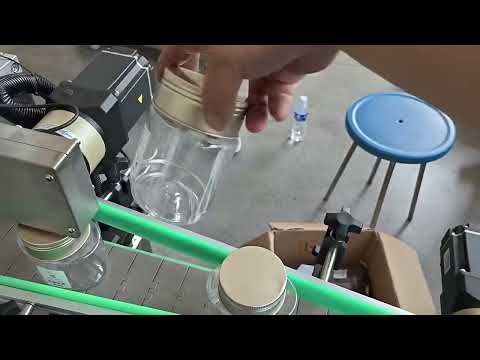
Why Is Pneumatic Alignment Used for This Oval Bottle?
Unlike a flat-sided container that can be guided against a defined surface, an oval bottle may require additional control to maintain the intended orientation as it travels through the conveyor. Pneumatic alignment assistance helps correct and stabilize the bottle before the two labeling heads apply the front and back labels.
The required handling method depends on the actual bottle geometry, surface, center of gravity, conveyor speed and label position. Bottle samples should therefore be tested before the final machine configuration is confirmed.
Double-Sided Labeling for Small Cosmetic Bottles
Small cosmetic containers can be more difficult to handle because their compact size provides less contact area for guiding and stabilization. This application shows continuous automatic conveying and double-sided labeling of small cosmetic bottles.
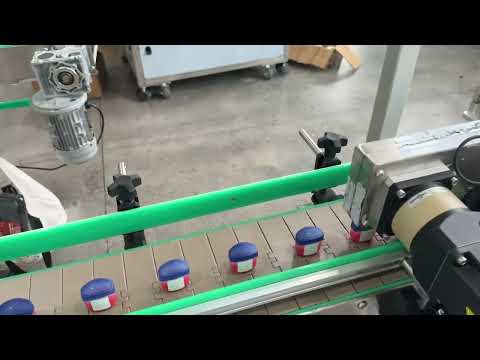
Small Cosmetic Container Labeling Application
Small cosmetic containers can require more careful guiding than larger bottles because their compact dimensions provide less contact area for stabilization. Stable bottle transfer helps maintain consistent label placement during continuous production.
The final machine setup should be selected according to the actual bottle dimensions, label size, labeling position and required production speed.
Watch Front & Back Bottle Labeling in Operation
To keep the page loading fast, the video loads only after clicking the play button.

Double-sided Labeling Machine Structure and Details
Review the dual labeling heads, bottle guiding system and machine structure to evaluate the configuration for your front and back labeling application.


Explore Other Labeling Machine Solutions
Different containers require different labeling methods. Explore more automatic labeling machines designed for various bottle shapes and production requirements.
Horizontal Round Bottle Labeling Machine
Designed for unstable cylindrical products such as ampoules, test tubes, syringes and small round bottles.
Learn More →Automatic Flat Top Labeling Machine
Ideal for labeling box lids, trays, cartons, bags and other flat surface products.
Learn More →Star Wheel Round Bottle Labeling Machine
Designed for continuous high-speed wrap-around labeling of round bottles requiring controlled bottle spacing and stable transfer.
Learn More →Front & Back Labeling Machine FAQs
Answers to common purchasing questions about bottle shapes, speed, accuracy, changeover and machine configuration.
What is a front and back labeling machine?
It is an automatic labeling machine that uses two labeling heads to apply separate front and back labels to a bottle or container during one continuous conveyor pass.
What bottle shapes can this double sided labeling machine handle?
The machine can be configured for flat, square, rectangular and oval bottles. Round bottles can also be evaluated with a suitable customized handling or wrap-around labeling configuration.
What is the maximum labeling speed?
The standard machine has a specified labeling speed of 20–200 pcs/min. Actual output depends on bottle shape, label size, labeling position, product handling and operating conditions.
What is the labeling accuracy?
Reference labeling accuracy is ±1 mm under suitable product and operating conditions. Bottle geometry, label material, fixtures and machine adjustment can affect actual performance.
Can the machine apply only one side label?
Yes. One labeling head can be selected when the product requires only single-side labeling.
Why do oval bottles need additional alignment?
Oval bottles are more sensitive to orientation because the front and back labels must reach corresponding surfaces. Depending on the bottle geometry, additional guiding, fixtures or alignment assistance may be used before label application.
Do I need to change fixtures for different bottle formats?
Different bottle formats may require corresponding fixture changes as well as guide and parameter adjustments. Bottle samples or detailed dimensions should be confirmed before the machine setup is finalized.
Can it label round bottles?
Round-bottle applications can be supported with a suitable customized configuration. A wrap-around labeling device can be added when the application requires circumferential labeling.
Can the labeler connect with filling and capping equipment?
For complete-line projects, integration with filling, capping, coding or downstream packaging equipment can be evaluated according to conveyor height, line speed, bottle transfer and control requirements.
What information should I provide for a quotation?
Please provide bottle shape and dimensions, bottle photos or samples, front and back label sizes, label positions, required speed, single-side or double-side requirement, product application and any optional functions.
Labeling Machine Guides & Technical Articles
Learn more about labeling machine selection, working principles and production applications from our technical guides.
How to Choose the Right Labeling Machine for Your Production Line
Understand how bottle shape, label position, production speed and automation requirements affect labeling machine selection.
Read More →Vertical Labeling Machine: Types, Working Principle & Buying Guide
Learn different labeling methods and how automatic labeling systems improve production efficiency.
Read More →Position Labeling Machine for Round Bottles: Complete Guide
Explore bottle positioning technology and solutions for accurate labeling applications.
Read More →Need a Front & Back Labeling Solution for Your Bottles?
Send us your bottle photos, bottle dimensions, front and back label sizes and target production speed. Our engineers will evaluate the bottle guiding method, labeling-head configuration and suitable machine setup.
Send Your Bottle & Label Requirements